
Green Coffee Market Size to Hit USD 54.5 Billion by 2034 | With a 3.48% CAGR
Green Coffee Market
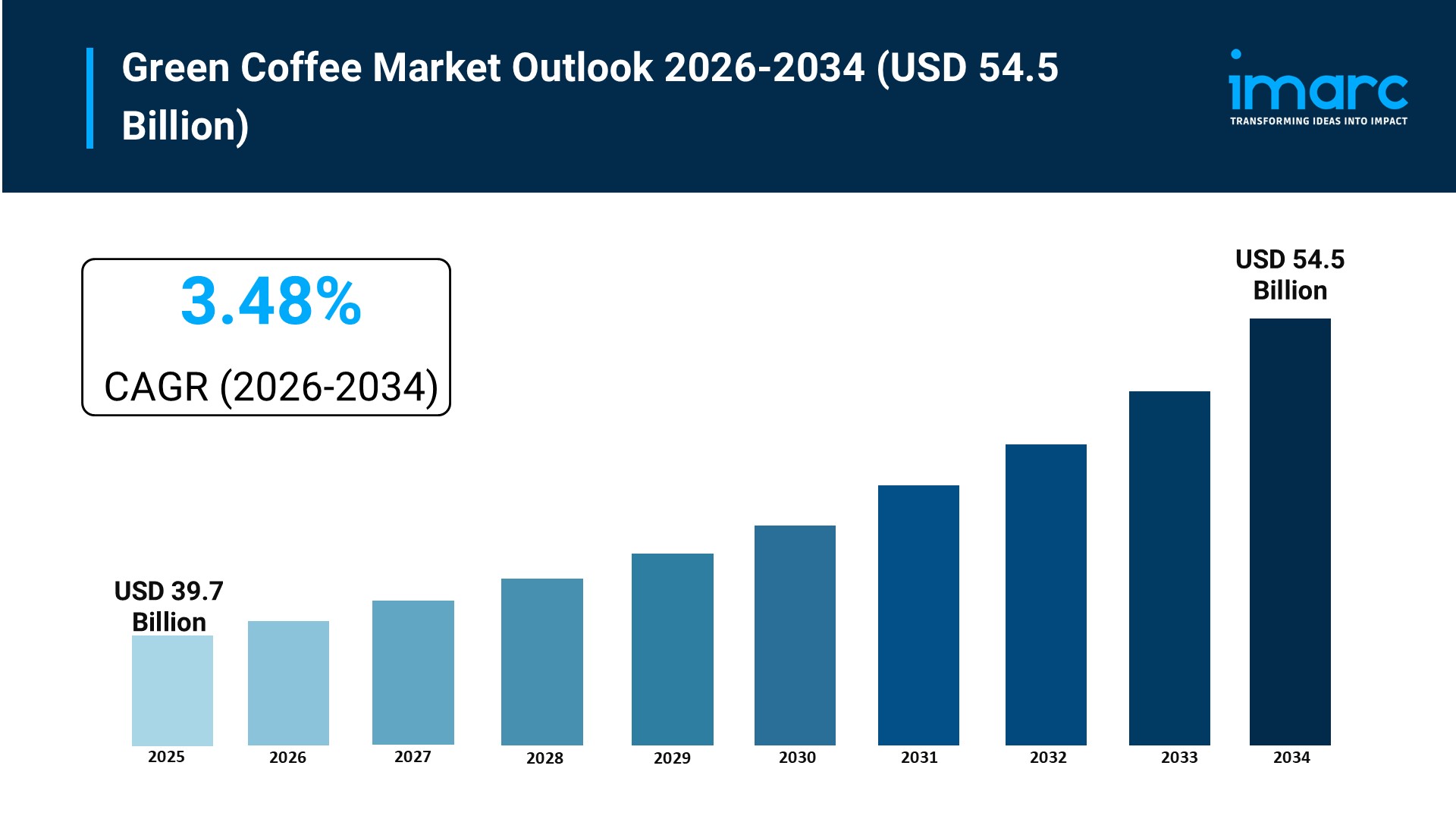
The global green coffee market size was valued at USD 39.7 Billion in 2025.
SHERIDAN, WY, UNITED STATES, April 27, 2026 /EINPresswire.com/ -- IMARC Group, a leading global market research and management consulting firm, has published its latest market intelligence report on the green coffee market. The global green coffee market size reached 𝑼𝑺𝑫 39.7 𝑩𝒊𝒍𝒍𝒊𝒐𝒏 𝒊𝒏 2025. Looking forward, IMARC Group expects the market to reach 𝑼𝑺𝑫 54.5 𝑩𝒊𝒍𝒍𝒊𝒐𝒏 𝒃𝒚 2034, exhibiting a growth rate (𝑪𝑨𝑮𝑹) 𝒐𝒇 3.48% during 2026-2034, driven by the rising demand for premium quality green coffee beans, significant expansion of the e-commerce sector, and the growing specialty coffee industry, which reflects consumer preferences for premium, sustainable, and unique coffee products.The market is experiencing strong growth momentum driven by the escalating global coffee consumption culture, the rapid emergence of specialty and single-origin green coffee as a mainstream consumer preference, and the broadening role of digital commerce platforms in facilitating direct trade between producers and buyers with greater price transparency and supply chain traceability. The International Coffee Organization projects that worldwide coffee consumption will increase by more than 3.0% in the current consumption cycle, with global consumption rising to 177.0 million bags, anchoring a structurally expanding base of raw green coffee bean demand across roasting, soluble processing, and ready-to-drink beverage manufacturing segments worldwide.
𝐇𝐨𝐰 𝐒𝐮𝐬𝐭𝐚𝐢𝐧𝐚𝐛𝐢𝐥𝐢𝐭𝐲 𝐚𝐧𝐝 𝐓𝐫𝐚𝐜𝐞𝐚𝐛𝐢𝐥𝐢𝐭𝐲 𝐀𝐫𝐞 𝐑𝐞𝐬𝐡𝐚𝐩𝐢𝐧𝐠 𝐭𝐡𝐞 𝐆𝐫𝐞𝐞𝐧 𝐂𝐨𝐟𝐟𝐞𝐞 𝐌𝐚𝐫𝐤𝐞𝐭
● Rise of Certified and Transparent Sourcing Standards: The Global Coffee Platform's Sustainable Coffee Purchases Report confirmed that approximately 75% of green coffee purchased by 11 of the world's largest buyers in 2024 met some form of sustainability standard, the highest proportion ever recorded, driven by growing buyer commitments to environmental compliance, farmer welfare, and supply chain accountability, with the overall volume of sustainably sourced green coffee growing by more than 170% since 2018, reaching 1,738,800 metric tons in 2024.
● EU Deforestation Regulation and Compliance-Driven Procurement Shifts: The European Union's anti-deforestation supply chain regulation is structurally redefining green coffee sourcing across European import markets, compelling roasters, traders, and retailers to prioritize certified, deforestation-free green coffee origins, with enforcement now extended to December 2026 for large companies and June 2027 for smaller companies following the European Parliament's November 2025 vote, while already having triggered significant front-loading of green coffee import volumes in anticipation of the original compliance deadline.
● Direct Trade and Digital Platforms Democratizing Producer Access: E-commerce and digital trading platforms are dismantling traditional brokerage barriers in the green coffee supply chain, enabling smallholder farmers in Brazil, Colombia, Ethiopia, and East Africa to engage directly with specialty roasters and institutional buyers, improving farmgate price realization, accelerating traceability, and enabling micro-lot and single-origin green coffee to command significant value premiums in consuming markets across North America, Europe, and Asia Pacific.
𝐃𝐨𝐰𝐧𝐥𝐨𝐚𝐝 𝐚 𝐬𝐚𝐦𝐩𝐥𝐞 𝐏𝐃𝐅 𝐨𝐟 𝐭𝐡𝐢𝐬 𝐫𝐞𝐩𝐨𝐫𝐭: https://www.imarcgroup.com/green-coffee-market/requestsample
𝐆𝐫𝐞𝐞𝐧 𝐂𝐨𝐟𝐟𝐞𝐞 𝐌𝐚𝐫𝐤𝐞𝐭 𝐓𝐫𝐞𝐧𝐝𝐬 𝐚𝐧𝐝 𝐃𝐫𝐢𝐯𝐞𝐫𝐬:
The global green coffee market is witnessing steady expansion, fueled by the deepening penetration of coffee culture across both mature and emerging consumer markets and the structural shift in consumer preferences toward premium, specialty, and sustainably sourced coffee products. The United States exemplifies this trajectory with particular force, as a consumer survey by the National Coffee Association of America found that nearly 48% of all coffee cups consumed in the United States are perceived as specialty coffee, while the U.S. coffee market carries an estimated retail value of USD 48 Billion, with specialty coffee constituting approximately 55% of that value share. The depth of this preference shift is further reflected in consumption demographics, with 31% of 18-year-olds reporting they consumed specialty coffee the day prior to the survey, confirming that younger consumer cohorts are driving sustained demand for the high-quality green coffee beans that underpin specialty roasting operations.
The e-commerce sector is emerging as one of the most consequential structural forces reshaping the green coffee market by enabling a new model of direct producer-to-buyer commerce that was previously inaccessible to smallholder growers. The global e-commerce market, currently valued at USD 21.1 Trillion, is expanding at a scale that is rapidly pulling the green coffee trade into the digital economy, providing producers with platforms to reach buyers across geographies while enabling buyers to access origin-specific green coffee with the traceability and quality documentation that specialty roasters and institutional purchasers increasingly demand. This digital commerce transformation is particularly impactful in regions such as East Africa and Central America, where coffee farmers producing distinctive micro-lot and single-origin green coffees now have direct pathways to global buyers willing to pay premium prices for verified quality and transparent sourcing.
The Specialty Coffee Association's National Coffee Data Trends report confirmed that over 80% of millennials recognize sustainable coffee and are willing to pay a premium for sustainably sourced products, a consumer behavioral signal that is reshaping procurement strategies across the green coffee supply chain and accelerating investments in quality control, origin certification, and farm-level traceability systems by major roasters, traders, and retailers worldwide.
𝐀𝐬𝐤 𝐚𝐧 𝐚𝐧𝐚𝐥𝐲𝐬𝐭 𝐟𝐨𝐫 𝐜𝐮𝐬𝐭𝐨𝐦𝐢𝐳𝐞𝐝 𝐫𝐞𝐩𝐨𝐫𝐭: https://www.imarcgroup.com/request?type=report&id=12057&flag=E
𝐆𝐫𝐞𝐞𝐧 𝐂𝐨𝐟𝐟𝐞𝐞 𝐈𝐧𝐝𝐮𝐬𝐭𝐫𝐲 𝐒𝐞𝐠𝐦𝐞𝐧𝐭𝐚𝐭𝐢𝐨𝐧:
The report has segmented the market into the following categories:
𝐁𝐫𝐞𝐚𝐤𝐮𝐩 𝐛𝐲 𝐓𝐲𝐩𝐞:
● Arabica
● Robusta
Arabica accounts for the majority of the market share. Arabica green coffee beans are globally prized for their smooth flavor profile characterized by nuanced sweetness and layered acidity, positioning them as the premium bean of choice for specialty roasters and discerning consumers seeking distinctive flavor sensations. According to International Coffee Organization data, global Arabica output accounts for approximately 57.4%, representing 102.2 million bags, while Robusta, contributing 75.8 million bags, remains indispensable for espresso blends and soluble coffee manufacturing owing to its higher caffeine content, stronger body, and superior extraction efficiency in industrial processing environments.
𝐁𝐫𝐞𝐚𝐤𝐮𝐩 𝐛𝐲 𝐏𝐫𝐨𝐝𝐮𝐜𝐭:
● Roasted Coffee
● Instant/Soluble Coffee
● Green Coffee Bean Extract
Roasted coffee holds the largest share of the industry. Green coffee beans destined for roasting represent the largest product application, serving a wide spectrum of end consumers ranging from specialty micro-roasters and artisanal coffee shops to large-scale commercial roasting operations and retail grocery chains, with the versatility of green beans enabling both home roasters seeking full control over flavor development and institutional buyers seeking consistent, high-volume supply for blended and single-origin roasted coffee products.
𝐁𝐫𝐞𝐚𝐤𝐮𝐩 𝐛𝐲 𝐃𝐢𝐬𝐭𝐫𝐢𝐛𝐮𝐭𝐢𝐨𝐧 𝐂𝐡𝐚𝐧𝐧𝐞𝐥:
● Hypermarkets and Supermarkets
● Departmental Stores
● Specialty Stores
● Online
● Others
𝐁𝐫𝐞𝐚𝐤𝐮𝐩 𝐛𝐲 𝐄𝐧𝐝 𝐔𝐬𝐞𝐫:
● Retail
● Coffee Cafes
● Others
𝐁𝐫𝐞𝐚𝐤𝐮𝐩 𝐛𝐲 𝐑𝐞𝐠𝐢𝐨𝐧:
● North America (United States, Canada)
● Asia Pacific (China, Japan, India, South Korea, Australia, Indonesia, Others)
● Europe (Germany, France, United Kingdom, Italy, Spain, Russia, Others)
● Latin America (Brazil, Mexico, Others)
● Middle East and Africa
Latin America dominates the global green coffee market on the supply side, with Brazil, Colombia, and other major producing nations benefiting from ideal climate conditions, large-scale cultivation infrastructure, and significant government and private investment in coffee farming and export logistics. Brazil serves as the world's single largest green coffee producer and exporter, anchoring global supply chains for both commodity-grade and specialty green coffee. On the demand side, North America and Europe represent the largest consuming regions, with the United States importing nearly 99% of its consumed coffee, making it highly dependent on green coffee imports from Latin America, Africa, and Asia, while Europe's EUDR compliance requirements are actively reconfiguring sourcing relationships toward certified, traceable green coffee origins across all major import markets.
𝐂𝐨𝐦𝐩𝐞𝐭𝐢𝐭𝐢𝐯𝐞 𝐋𝐚𝐧𝐝𝐬𝐜𝐚𝐩𝐞:
The report provides a comprehensive analysis of the competitive landscape in the green coffee market with detailed profiles of all major companies, including:
● Atlantica Coffee (Montesanto Tavares Group)
● Belco S.A.
● Golden Bean Trade
● Merchants of Green Coffee
● Neumann Kaffee Gruppe
● Nordic Approach AS
● The Bean Coffee Company
● The Green Coffee Brazil (Group MAGNUS BRAZIL)
● WSCafe
𝐎𝐭𝐡𝐞𝐫 𝐓𝐫𝐞𝐧𝐝𝐢𝐧𝐠 𝐑𝐞𝐩𝐨𝐫𝐭𝐬 𝐁𝐲 𝐈𝐌𝐀𝐑𝐂 𝐆𝐫𝐨𝐮𝐩:
Fast Food Market Research Report
Customer Relationship Management Market Research Report
Cannabidiol Market: https://www.imarcgroup.com/cannabidiol-market
Honey Market: https://www.imarcgroup.com/honey-market
Polyvinyl Chloride Market: https://www.imarcgroup.com/polyvinyl-chloride-market
𝐑𝐞𝐜𝐞𝐧𝐭 𝐍𝐞𝐰𝐬 𝐚𝐧𝐝 𝐃𝐞𝐯𝐞𝐥𝐨𝐩𝐦𝐞𝐧𝐭𝐬 𝐢𝐧 𝐭𝐡𝐞 𝐆𝐫𝐞𝐞𝐧 𝐂𝐨𝐟𝐟𝐞𝐞 𝐌𝐚𝐫𝐤𝐞𝐭
● July 2025: Louis Dreyfus Company doubled its coffee storage and processing capacity at its Varginha, Brazil hub, directly responding to rising global demand for green coffee by expanding its physical infrastructure and logistics capabilities at one of the world's most strategically significant green coffee processing and export centers, enabling higher throughput, faster order fulfillment, and greater supply chain reliability for its institutional and specialty buyer network.
● December 2025: The Global Coffee Platform published its Sustainable Coffee Purchases Report, revealing that the overall volume of sustainably sourced green coffee purchased by major global buyers reached 1,738,800 metric tons in 2024, a growth of more than 170% since 2018, with 75% of purchases by 11 leading roasters and retailers meeting recognized sustainability standards, covering more than 2.6 million coffee farmers and 5.8 million hectares under coffee cultivation globally.
● November 2025: The Specialty Coffee Association of Ethiopia launched its plans, with prominent Ethiopian green coffee professionals coming together to form a new national trade organization designed to elevate Ethiopia's specialty coffee sector, protect its coffee heritage, improve quality standards, and expand market access for Ethiopian producers in the global green coffee trade, directly addressing the gap between Ethiopia's extraordinary genetic coffee diversity and its underrepresented position in premium international markets.
● June 2024: Westrock Coffee Company inaugurated North America's largest roast-to-ready-to-drink manufacturing facility in Conway, Arkansas, a USD 315 million investment spanning 570,000 square feet, featuring an extensive beverage development laboratory and solidifying Westrock's leadership in green coffee processing, roasting, and ready-to-drink beverage innovation and production at industrial scale.
● October 2024: JAB Holding acquired Mondelez's 17.6% stake in JDE Peet's for USD 2.3 Billion, raising its ownership to 68% and significantly consolidating its dominant position within the global green coffee supply chain, roasting, and branded coffee product ecosystem, signaling continued investor confidence in the long-term demand fundamentals of the global coffee market.
Note: If you require specific details, data, or insights that are not currently included in the scope of this report, we are happy to accommodate your request. As part of our customization service, we will gather and provide the additional information you need, tailored to your specific requirements. Please let us know your exact needs, and we will ensure the report is updated accordingly to meet your expectations.
𝐊𝐞𝐲 𝐐𝐮𝐞𝐬𝐭𝐢𝐨𝐧𝐬 𝐓𝐡𝐢𝐬 𝐑𝐞𝐩𝐨𝐫𝐭 𝐀𝐧𝐬𝐰𝐞𝐫𝐬
● What is the current global green coffee market size and what is its projected value?
● Which type segment holds the largest share in the global green coffee market?
● What are the key consumer behavioral and structural drivers of global green coffee market growth?
● Which region dominates the global green coffee market on both the supply and demand side?
● How are sustainability regulations, e-commerce expansion, and specialty coffee culture reshaping sourcing models and competitive dynamics in the green coffee industry?
● Who are the top companies in the global green coffee market and what are their competitive strategies?
● What are the investment and market entry opportunities across roasted coffee, instant coffee, and green coffee bean extract segments?
𝐀𝐛𝐨𝐮𝐭 𝐔𝐬:
IMARC Group is a global management consulting firm that helps the world's most ambitious changemakers to create a lasting impact. The company provides a comprehensive suite of market entry and expansion services. IMARC offerings include thorough market assessment, feasibility studies, company incorporation assistance, factory setup support, regulatory approvals and licensing navigation, branding, marketing and sales strategies, competitive landscape and benchmarking analyses, pricing and cost research, and procurement research.
𝐌𝐞𝐝𝐢𝐚 𝐚𝐧𝐝 𝐒𝐚𝐥𝐞𝐬 𝐂𝐨𝐧𝐭𝐚𝐜𝐭
IMARC Group
Email: sales@imarcgroup.com
United States: +1-201-971-6302
India: +91-120-433-0800
United Kingdom: +44-753-714-6104
Elena Anderson
IMARC Services Private Limited
+1 201-971-6302
email us here
Legal Disclaimer:
EIN Presswire provides this news content "as is" without warranty of any kind. We do not accept any responsibility or liability for the accuracy, content, images, videos, licenses, completeness, legality, or reliability of the information contained in this article. If you have any complaints or copyright issues related to this article, kindly contact the author above.
