

How Enterprises Are Managing Control in the Age of AI
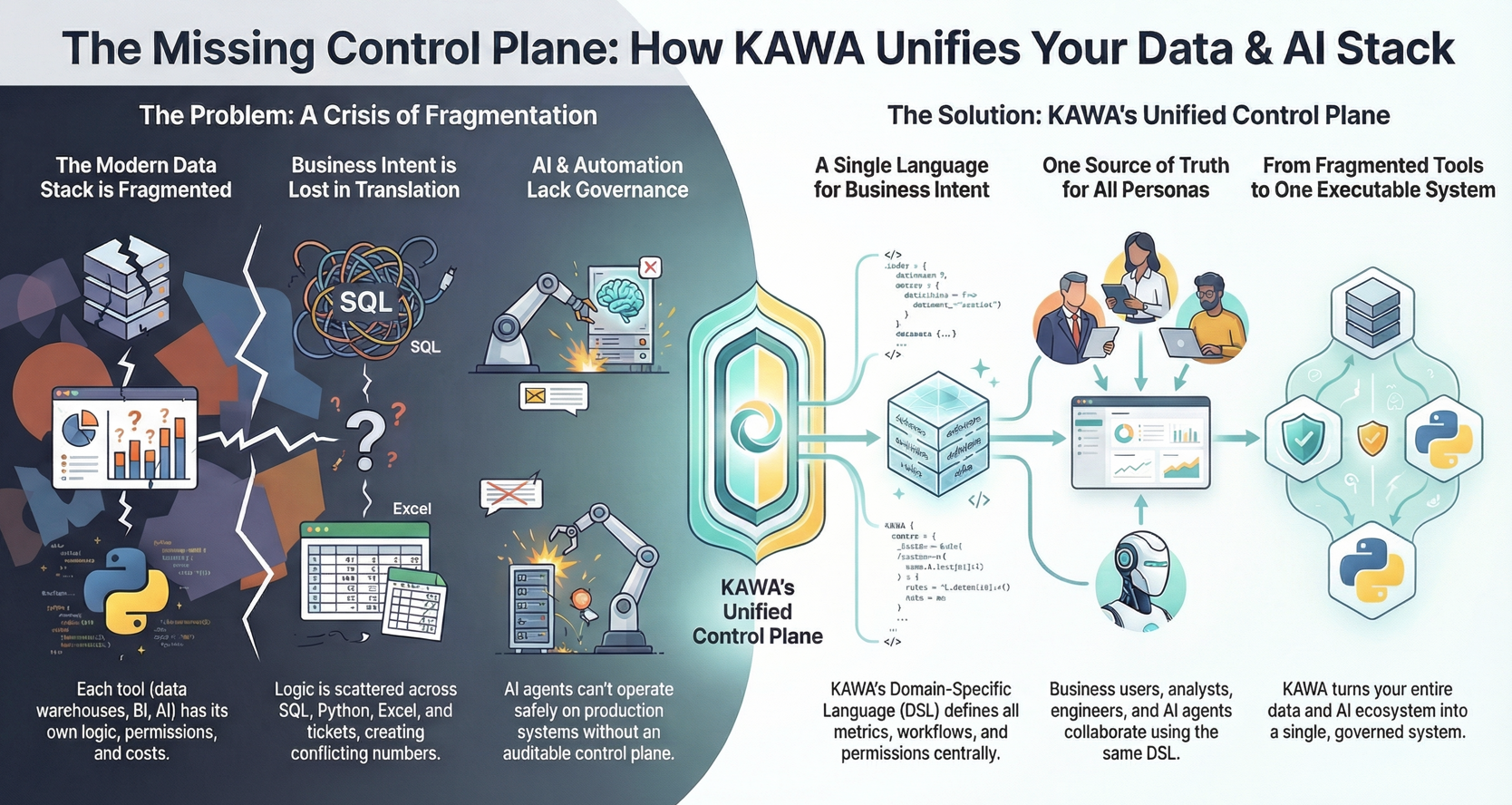
KAWA’s unified control plane replaces fragmented tools with a single governed system where data, business logic, workflows, and AI operate together.
As AI systems begin to act, enterprises face a new crisis: how to govern decisions, risk, and compliance in a world run by software.
This shift is not incremental. It represents a fundamental inversion of how enterprise software has operated for decades. Traditional systems assumed that people would decide and software would execute. Agentic AI reverses that logic. Software now decides and people are asked to supervise. That inversion is what makes the current moment so dangerous, not because the models are unreliable, but because the enterprise technology stack was never designed to be operated by autonomous systems.
“Agentic AI is not a tooling upgrade, it is a control problem,” said Mark Ayzenberg, Chief Revenue Officer at KAWA. “The moment software can take action inside revenue, risk, or operations, the enterprise either has a governed execution layer or it has exposure. What we built at KAWA is the missing control plane that lets organizations move from AI experimentation to AI execution without losing accountability, compliance, or trust.”
Most enterprises have spent the last twenty years investing in three categories of technology. They built systems of record such as data warehouses, transaction platforms, and core processing engines. They layered on systems of insight, including business intelligence tools, notebooks, and machine learning platforms. They added systems of interaction such as CRMs, workflow engines, and customer portals. What they did not build is a system of execution, a unified layer where data, business logic, permissions, workflows, and decisions are governed as one.
When companies deploy agentic AI today, they place models on top of fragments of this fragmented stack. The model can see data. It can produce outputs. It can trigger actions through APIs. But it has no native understanding of what it is allowed to do, what must be approved, what is regulated, or what must be logged. There is no single, authoritative layer that defines the rules of the enterprise and enforces them as software operates. As a result, enterprises cannot answer the most basic questions that regulators, auditors, and boards will demand: what did the AI do, why did it do it, and was it permitted to do so.
This is why so many agentic AI initiatives stall as soon as they move out of experimentation. The issue is not whether the model is accurate. The issue is whether the enterprise can trust the system enough to let it operate in production. In highly regulated, high-stakes environments such as financial services, energy trading, insurance, and supply chains, every automated action has legal, financial, and reputational consequences. Without a control layer that governs execution, agentic AI becomes an uncontrolled source of systemic risk.
What the next generation of enterprise architecture requires is a true control plane. A control plane is the layer where business logic is defined, data quality is enforced, permissions are applied, workflows are orchestrated, and AI agents are constrained and observed. It is the layer that turns intelligence into accountable execution. In every other high-risk domain, from aviation to manufacturing to electronic trading, autonomous systems operate inside tightly governed control frameworks. Enterprise AI will be no different. Without a control plane, autonomy is simply chaos at scale.
This is the architectural gap that KAWA was built to fill. KAWA is not another analytics product, workflow engine, or AI toolkit. It is an enterprise execution control plane. At its core is a proprietary domain-specific language, KAWA DSL, that allows organizations to define their data logic, business rules, permissions, workflows, and AI agents in a single governed, executable layer. Instead of scattering decisions across notebooks, scripts, and disconnected platforms, everything that matters to how the business runs is encoded, enforced, and audited in one place.
That design allows enterprises to deploy agentic AI without surrendering control. Models can act, but only within defined guardrails. Data can change, but only through governed logic. Workflows can run, but every step is traceable. Compliance teams can see not just outcomes, but the chain of reasoning and authorization behind them. This is what it means to move from AI experiments to AI operations.
The enterprises that will win in the agentic era will not be the ones with the most sophisticated models. They will be the ones with the strongest execution architecture. They will be able to prove, in real time, that their AI systems operate within policy, respect risk limits, and produce audit-ready evidence of every decision. That capability will become a competitive advantage, not only with regulators and customers, but with boards that understand the difference between innovation and unmanaged risk.
The question every enterprise leader should now be asking is not whether to adopt agentic AI, but how to control it. The age of AI has arrived. The age of governed, executable AI is just beginning. KAWA exists to help enterprises lead that transition. If your organization is deploying or planning to deploy AI that takes real action in revenue, risk, operations, or compliance, the architecture you choose will determine whether that future is scalable or fragile. To learn how a true enterprise control plane can make agentic AI safe, auditable, and operational, engage with KAWA and begin building the execution layer your business will soon depend on.
Mark Ayzenberg
KAWA AI
Mark.ayzenberg@kawa.ai
Visit us on social media:
LinkedIn
Agentic AI: Control or Chaos?
Legal Disclaimer:
EIN Presswire provides this news content "as is" without warranty of any kind. We do not accept any responsibility or liability for the accuracy, content, images, videos, licenses, completeness, legality, or reliability of the information contained in this article. If you have any complaints or copyright issues related to this article, kindly contact the author above.
