

New Report Urges K-12 Schools to Stop Treating AI as a Specific Problem to Be Solved
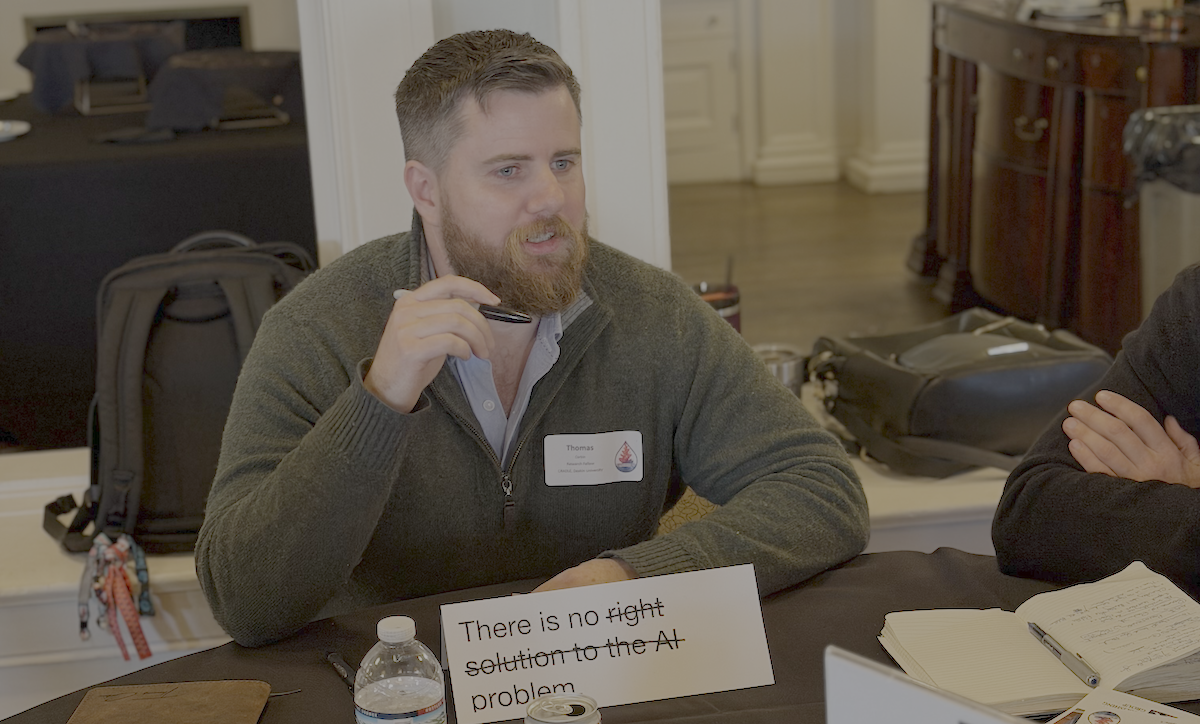
Thomas Corbin leads a discussion during the TeachingAbout.AI Convening.
TeachingAbout.AI’s field report reframes artificial intelligence as an ecological force reshaping teaching, assessment, and the role of the teacher.
LE ROY, NY, UNITED STATES, June 9, 2026 /EINPresswire.com/ -- A new report released today by the TeachingAbout.AI project, funded by Google, challenges the dominant approach to artificial intelligence in K-12 education, arguing that schools rushing to write AI policies, purchase detection software, and ban chatbots are spending their energy on the wrong problem.Titled Teaching About AI: A Report for the K-12 Field, the report is built on the Rochester Provocations — eight deliberately uncomfortable statements developed in December 2025 by a panel of school librarians, classroom teachers, instructional leaders, university researchers, and technologists who met over four days in Rochester, New York. Funded by Google and released under a Creative Commons license, the report is freely available at teachingabout.ai.
The report’s central argument borrows from media theorist Neil Postman: technological change is ecological, not additive. A drop of red dye in a beaker of clear water does not leave you with clear water plus dye — it leaves you with a beaker of red water. Generative AI, the authors contend, has not left schools with their old system plus a chatbot. It has changed every relationship in the building, from teacher and student to school and community, and surfaced problems that long predate it.
“The deepest issues AI has raised in schools — cheating, the validity of our assessments, the purpose of homework, what only a human teacher can do — are not new problems caused by AI,” said Christopher Harris, Ed.D., project lead and director of Libraries and Digital Learning Services at Genesee Valley BOCES. “They are old, unresolved problems that AI has made impossible to ignore. AI is the catalyst, not the cause. The real crisis is whether we have the courage to use this moment to fix what was already broken.”
The Eight Rochester Provocations
Rather than offer another set of acceptable-use rules, the report frames the conditions under which honest solutions become possible:
1. There is no AI problem. Education itself is a wicked problem.
2. We can be agents of validity or victims of cheating.
3. Our assessments were broken before AI.
4. There is no such thing as AI-proof.
5. Most things a human teacher can do, AI can mimic.
6. Teachers must have permission to compromise, diverge, and iterate.
7. The real AI crisis is how we take advantage of the opportunity.
8. Avoidance of AI in education is not an option.
Each provocation is paired with peer-reviewed research and concrete recommended actions for the people the report says will make AI integration succeed or fail: classroom teachers, school librarians, principals, and curriculum directors. Instead of chasing “AI-proof” assessments — which the panel calls “a problematically alluring impossibility” — the report urges districts to rebuild assessment validity, replace AI bans and mandates with harm-reduction policies, and protect the relational work that only human teachers can do.
School Librarians at the Center
The report makes a pointed case for school librarians as the natural leaders of this work. Through the LibraryReady.AI PreK–12 scope and sequence, it argues, librarians are already “the closest thing most districts have to AI-fluent instructional leaders” — teaching across grade levels, modeling information evaluation and ethics, and building the partnerships the next phase requires. They should be “at the center of every district AI conversation,” the report states, “not waiting for an invitation to it.”
Callouts for Higher Education and Public Libraries
Callout boxes throughout the report extend the work beyond the K-12 classroom. For higher education, it urges joint convenings between districts and regional schools of education — noting that pre-service teacher programs are “downstream of every K-12 decision” districts make about AI — and proposes regional fellowships that pair K-12 teachers with assessment researchers. For public libraries, described by one panelist as “a force multiplier,” the report calls for coordinated AI-literacy messaging that closes the home-school loop and treats public librarians as co-curriculum designers rather than audiences.
Christopher Harris
Genesee Valley BOCES
cgharris@gvboces.org
Visit us on social media:
LinkedIn
Legal Disclaimer:
EIN Presswire provides this news content "as is" without warranty of any kind. We do not accept any responsibility or liability for the accuracy, content, images, videos, licenses, completeness, legality, or reliability of the information contained in this article. If you have any complaints or copyright issues related to this article, kindly contact the author above.
